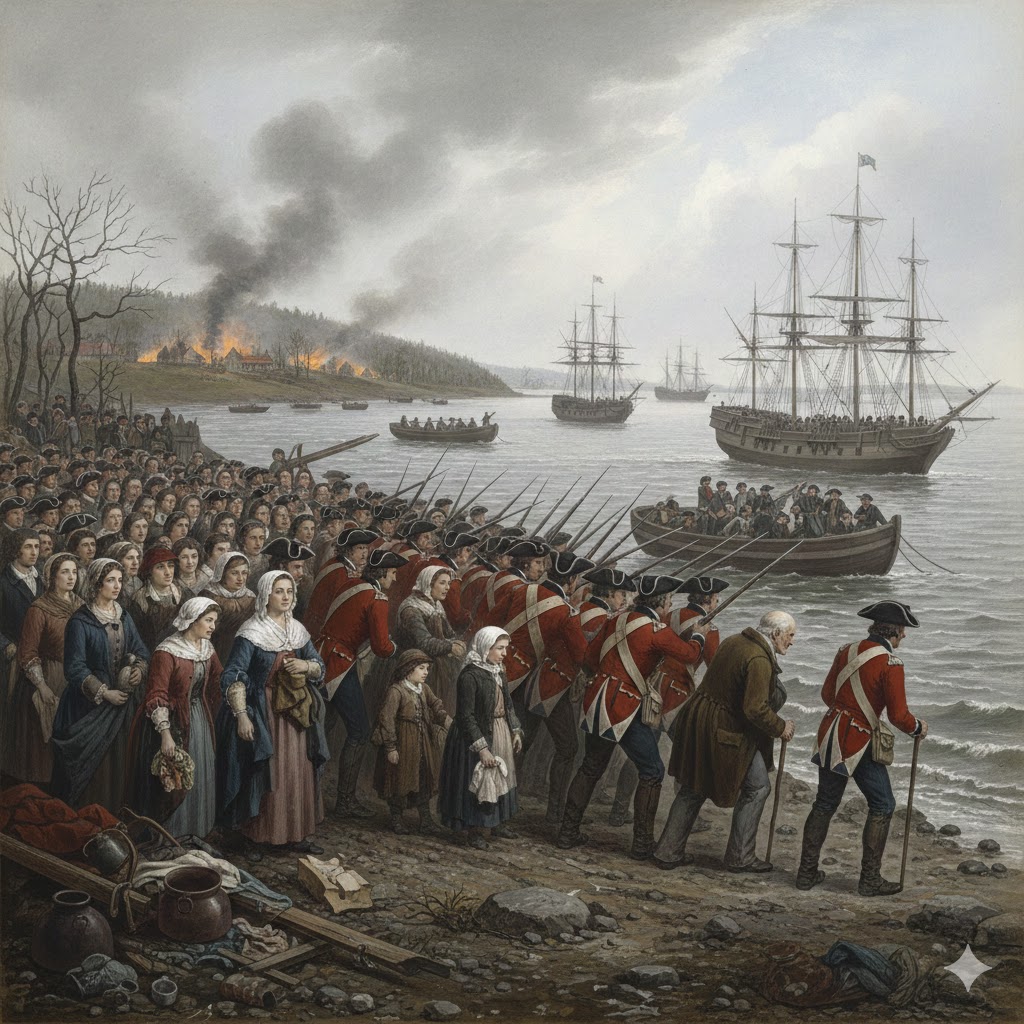
Losing Acadia
Story Summary
Will the Boston colonists hang Marie Benoit, the 17-year-old French Neutral who has been exiled to their town? Pregnant, unmarried and Catholic, Marie Benoit is determined to return Acadia, the place the British now call Nova Scotia, to reunite with her fiancé. But the colonists suspect she’s a spy as the French Indian War is about to start.
History
Between 1755 and 1762, British soldiers and militia from the colony of Massachusetts forcibly removed nearly 10,000 French-speaking residents from Acadia (Nova Scotia). During this period of ethnic cleansing, people lost their homes, land and possessions. Many Acadians also lost their lives. Those who survived the ocean voyages on overcrowded sloops were scattered throughout the British colonies, most especially in Massachusetts.
The governor of Massachusetts expected the younger Acadians to assimilate. Boys and girls were forced to work as indentured servants. Colonists were asked to house the Acadians who were given food and milk every week, but most could not find work.
While the French Indian War raged, the Acadians were not allowed to practice Catholicism in the heavily Protestant colonies. Maryland was the exception.
At the end of the war, several hundred Acadians petitioned for and were granted the right to return home. They walked from Boston to the mainland part of Acadia which is now New Brunswick. Other Acadians tried to reclaim their land. But the King of England had already given the best farmland to Boston colonists who wanted to resettle in the region.
The Acadians were given small parcels of interior land. Others agreed to work as dam builders for the British because they understood how to manage the farmland in order to grow salt hay. They were still forbidden to practice their religion.
One group of Acadians sought a better life elsewhere. Beausoleil, a fierce defender of Acadia and British foe, eventually led several Acadians south. They traveled to southern coast of what is now Louisiana. Their settlements and intermingling with escaped enslaved Africans and Native Americans led to the development of the Cajun culture in the Bayou.
Still other Acadians assimilated into colonial life and became part of early American history as they rebelled against the increasing taxes being levied by the King of England. By 1783, they fought with the colonists in the American Revolution.
In 2003, Queen Elizabeth II formally apologized to the Acadians for the actions taken against them by the representatives of the King of England in 1755-1757.
Suggested Reading
The Acadian Expulsion 2025
Massachusetts Town Records.
Powell, Allen. Strangers in a Strange Land.
Some exiles in MD chose to stay and changed their names.
Acadian Ancestral Home.
A site cataloging the travels of Acadians after the Expulsion